Products Rauzr Helix Dossiq

Dossiq · The first Rauzr Helix agent

Prepare the dossier. Find the discrepancies. Suggest the fix.

Dossiq agents work across R&D, QC, and QA documents for a generic variation — CTD Module 3, US CBE-30 and EU Type IB. They prepare the package, flag what disagrees, and propose how to resolve it. Your regulatory affairs team decides and files.

The screens on this page are the product interface filled with a sample variation. They are not a customer engagement and not a measure of performance.

Why it matters

From about 20 days to a few hours

Manual package review by an RA expert

~20 days

What Dossiq is built to check in

a few hours

A dossier package review that takes an RA expert about 20 days, Dossiq is built to check in a few hours. Your experts spend their time on decisions, not searching.

Typical manual review time reported by regulatory affairs teams; Dossiq timing depends on package size.

What the agents do

Three steps, one package.

Preparing the dossier is the start. The value is in the discrepancies between documents, and a concrete way to resolve each one.

  1. 01Prepare

    Assemble the dossier from source.

    Agents read R&D, QC, and QA documents and the last approved sequence, and build the CTD Module 3 package for the variation. Every extracted fact carries a document, page, and span.

    For exampleDrug substance spec, analytical method, stability report, and regional letter, gathered into one package.

  2. 02Find discrepancies

    Surface what disagrees across documents.

    Deterministic rules compare the facts across departments and against the approved baseline. Each mismatch becomes a finding with its rule id and both sources linked.

    For exampleA spec limit the analytical method does not test to. A stability conclusion the data does not support. Impurity wording that differs between spec and release text.

  3. 03Suggest resolution

    Propose how to fix it, with the sources.

    For each finding, the agent drafts a resolution and points at the pages it relies on. Regulatory affairs accepts, edits, or rejects it, and files outside Dossiq.

    For exampleAlign the method's acceptance criterion to the current spec. Restate the shelf-life to the supported timepoint. Harmonize the impurity name in the release text.

People stay on the decision. Dossiq prepares, finds, and suggests. Your regulatory affairs team decides every disposition and files with the agency. Dossiq never submits.

Trust model

Rules find it. You verify it by asking.

Every finding has a rule and a citation. If you doubt one, ask the package and read the page.

Rules

Deterministic, and named on the finding.

Checks compare cited facts across documents and against the approved baseline. The same inputs give the same result, and the rule id is stored on the finding. The model does not vote on pass or fail.

See the findings queue
Ask

Double-check any finding with a question.

Ask the package answers only with document, page, and span. “What does the QC method test impurity B against?” comes back with the source. Ask never opens, closes, or grades a finding.

See Ask on a package

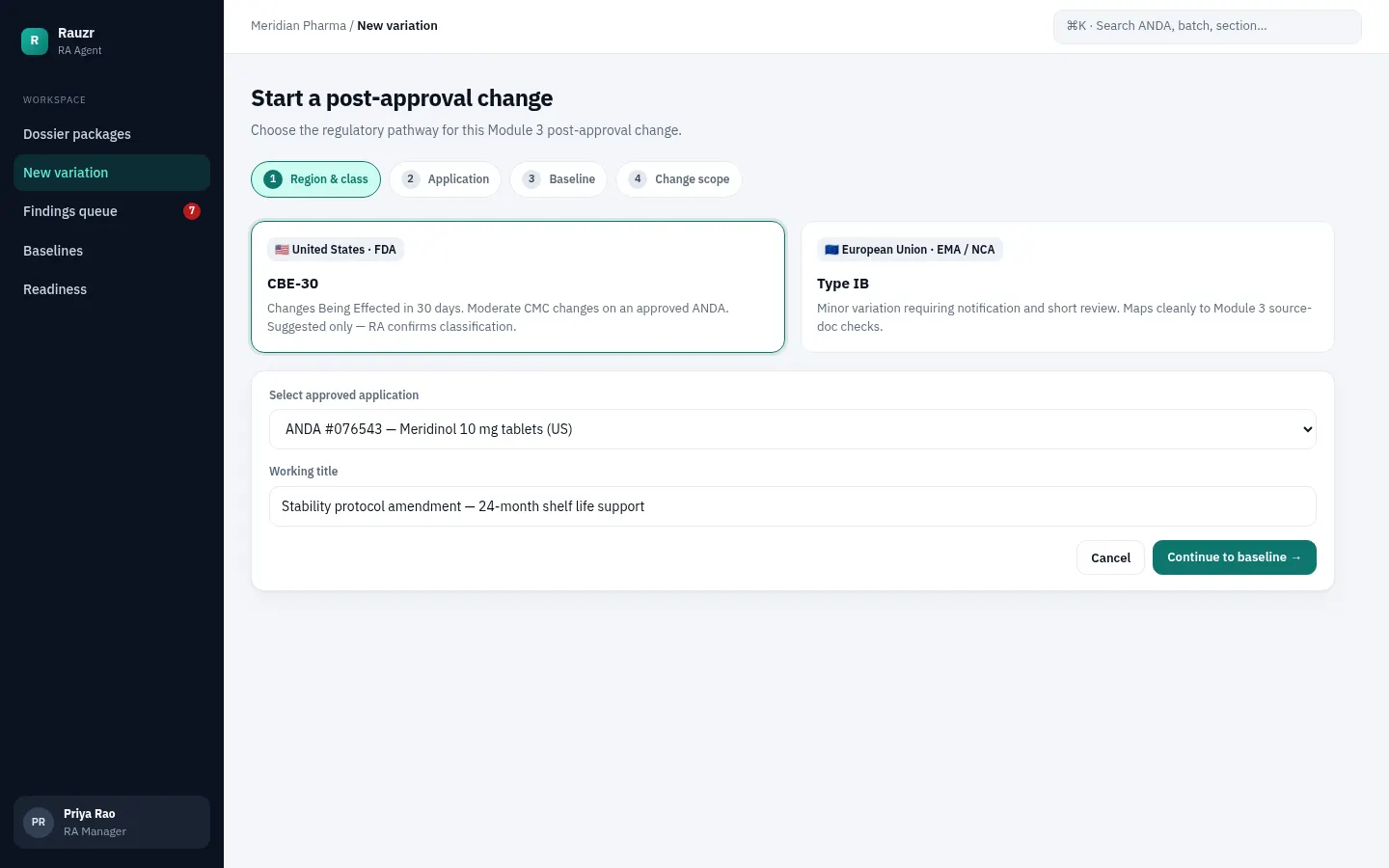
01

Start from an approved sequence.

A variation names its pathway, anchor product, sequence, regions, and the CTD sections it will touch. US CBE-30 and EU Type IB are the pathways Dossiq is built around. The anchor is an approved product and sequence.

Scope is explicit: drug substance, drug product, analytical procedures, stability, regional administrative documents. The package can be created or kept as a draft. Nothing is transmitted.

Dossiq · Start a variationSample data
Dossiq screen for starting a variation. Fields cover pathway, anchor product and sequence, regions, and CTD scope, with actions to create the package or save a draft.
Sample variation in the Dossiq interface. Not a customer result or a performance claim.

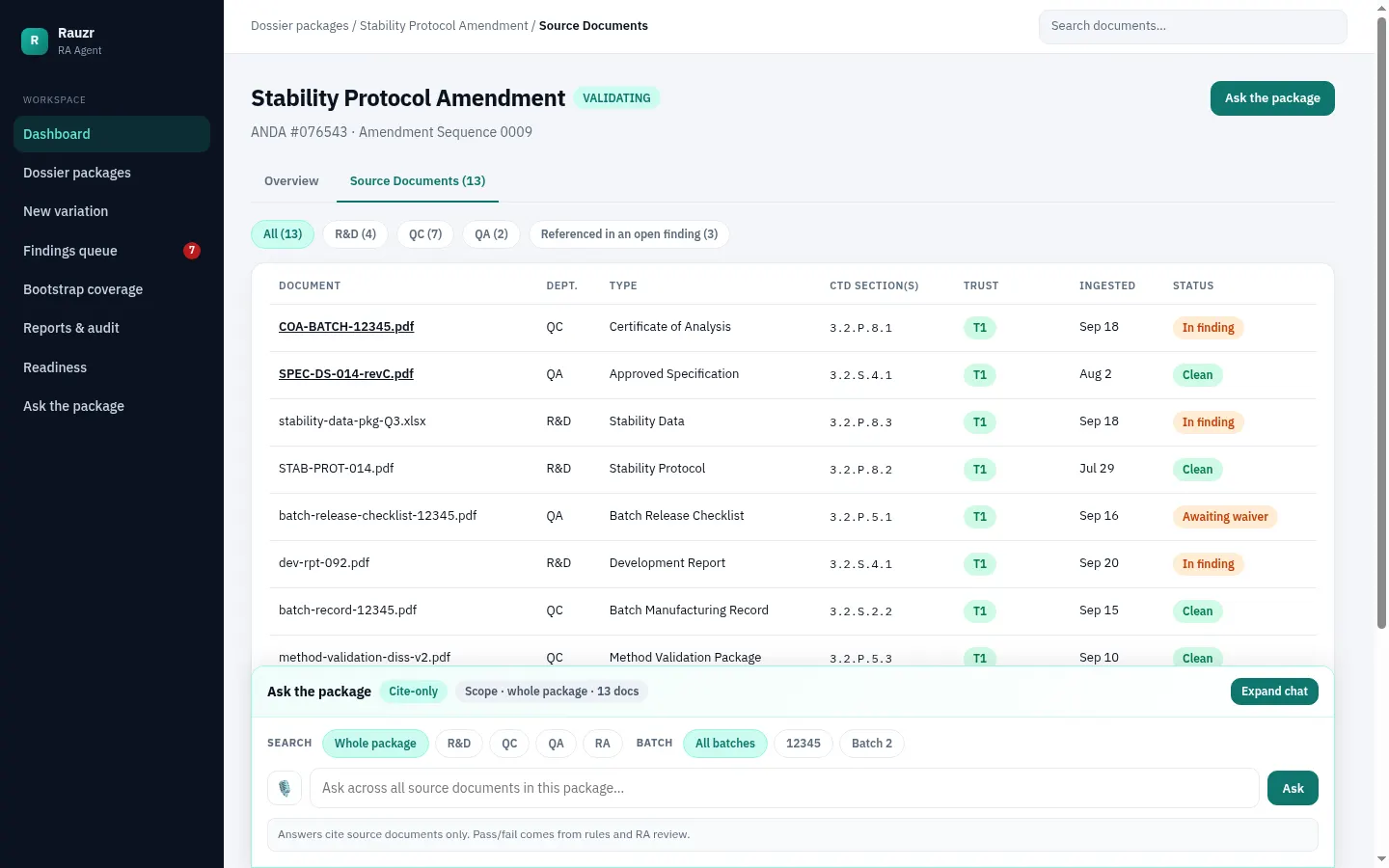
02

One inventory for the source documents.

R&D, QC, and QA documents land in a single list: department, type, version, batch, tier, and status. A row can be read, parsing, queued, or blocked. A scanned specification that produced no text stays blocked. It is not treated as reviewed.

Active, reference, and superseded versions stay distinct. Filters cover department, tier, and batch, so a question about one lot does not silently search the whole history.

Dossiq · Source documentsSample data
Dossiq source document inventory for a sample variation. Rows list department, document type, version, batch, tier, and status, with filters for department, tier, and batch.
Sample variation in the Dossiq interface. Not a customer result or a performance claim.

03

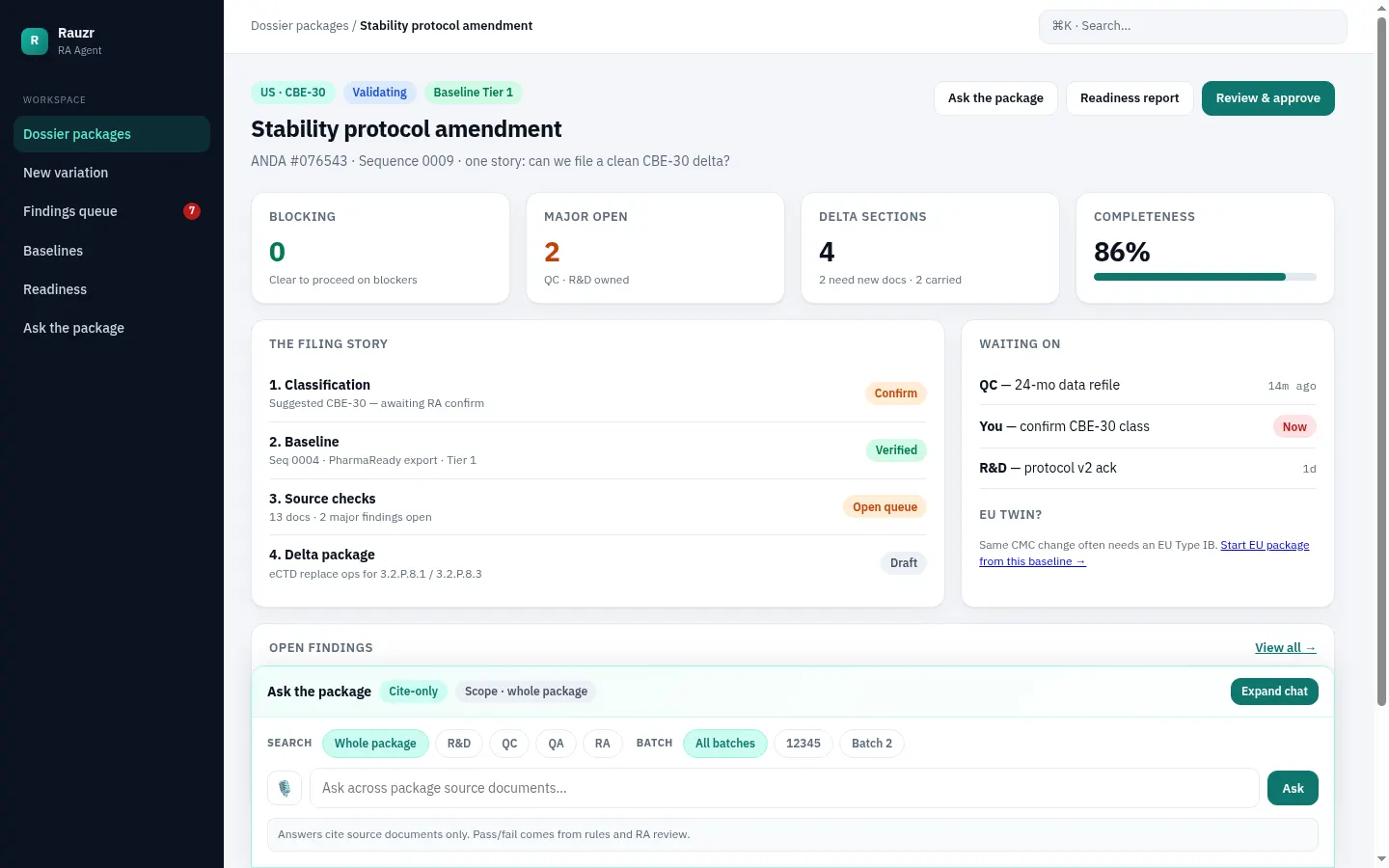
Package home is a status, not a score.

Once the variation exists, home shows blocking findings, major findings still open, major findings waived, and section completeness. Recent activity is attributed: who re-submitted a document, who waived a finding, and that a justification was logged.

The baseline sits beside that status, with its trust tier. Tier 1 is a source document — an approved sequence ingested, with the export path recorded. Completeness here describes the sample package on screen. It is not a Rauzr performance figure.

Dossiq · Package homeSample data
Dossiq package home for a sample variation, with blocking findings, major findings open and waived, section completeness, a CTD section list, baseline trust tier, and recent activity.
Sample variation in the Dossiq interface. Not a customer result or a performance claim.

04

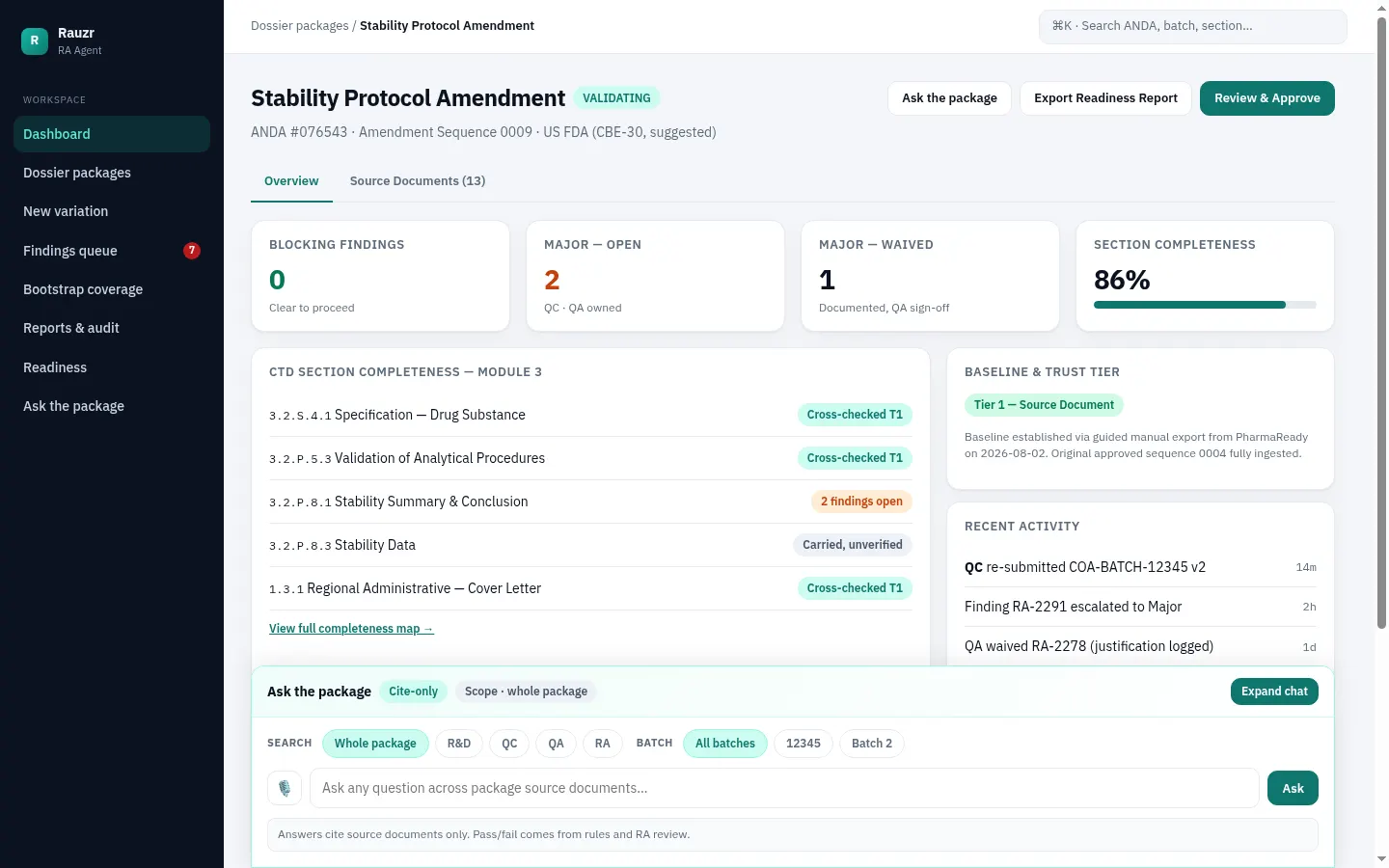
Module 3, section by section.

The overview lists CTD sections and a state for each: cross-checked against a tier, findings open, or carried and unverified. A carried section is labeled unverified. It is not displayed as a pass.

The same screen holds Ask the package, scoped to the whole package, still cite-only. Pass and fail stay with rules and with RA review.

Dossiq · Section completenessSample data
Dossiq overview of CTD Module 3 for a sample Stability Protocol Amendment, including cross-checked sections, open findings, a carried unverified section, a Tier 1 baseline, and the Ask the package panel.
Sample variation in the Dossiq interface. Not a customer result or a performance claim.

05

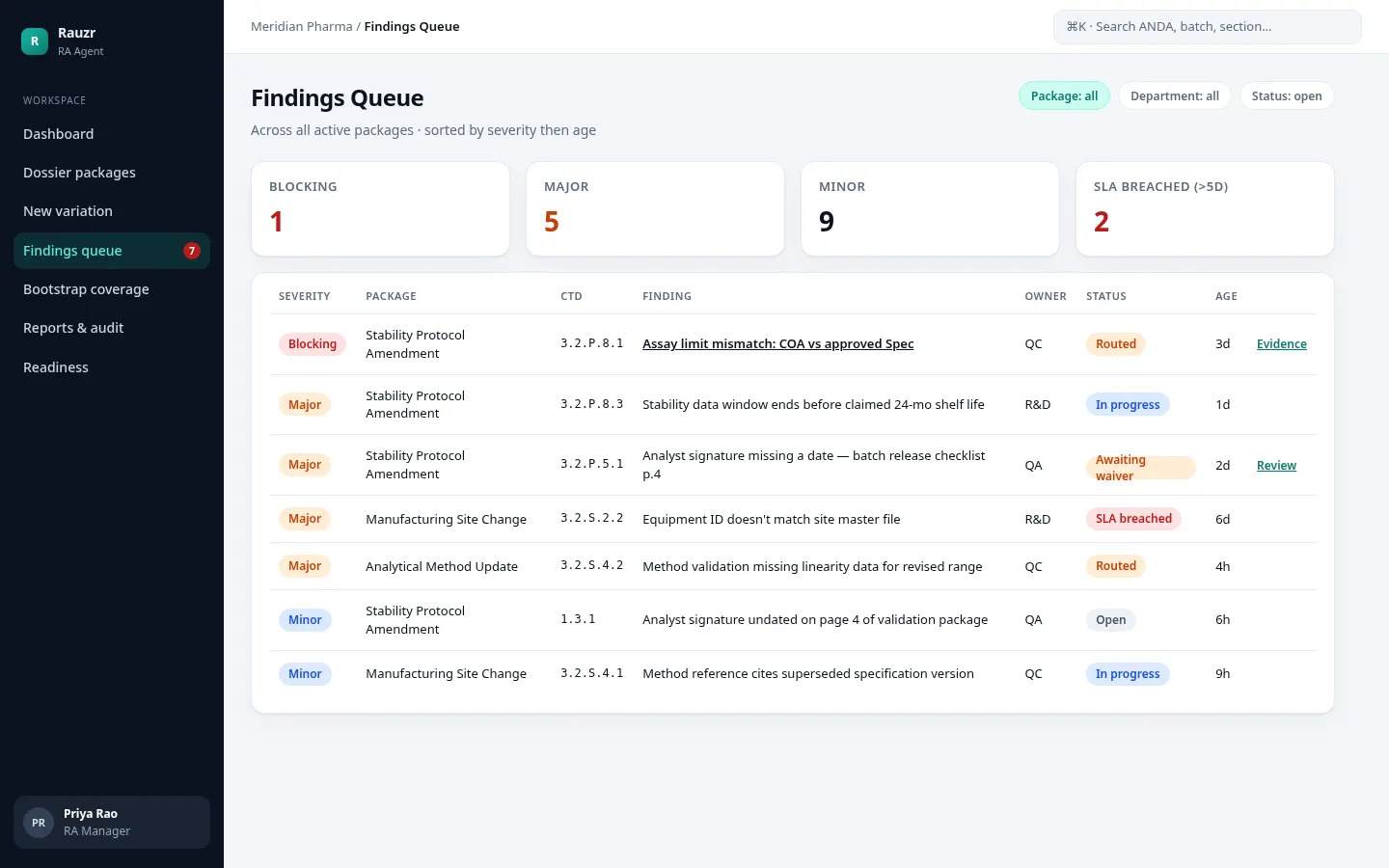
Findings the team can arbitrate.

The queue filters by severity, status, source, owner, and CTD section. Each row names a rule or marks itself human, and stores linked documents. Critical, major, and minor stay separate. Blocking findings are called out on their own.

Inside a finding: the rule id, the documents it used, and a thread. Regulatory affairs can assign, comment, and move state. A waiver requires a justification. RA can also raise a finding the rules did not.

Dossiq · Findings queueSample data
Dossiq findings queue for a sample package. The list shows severity, CTD section, Rule or Human source, owner, and state. The open drawer shows a rule, linked documents, and comments.
Sample variation in the Dossiq interface. Not a customer result or a performance claim.

06

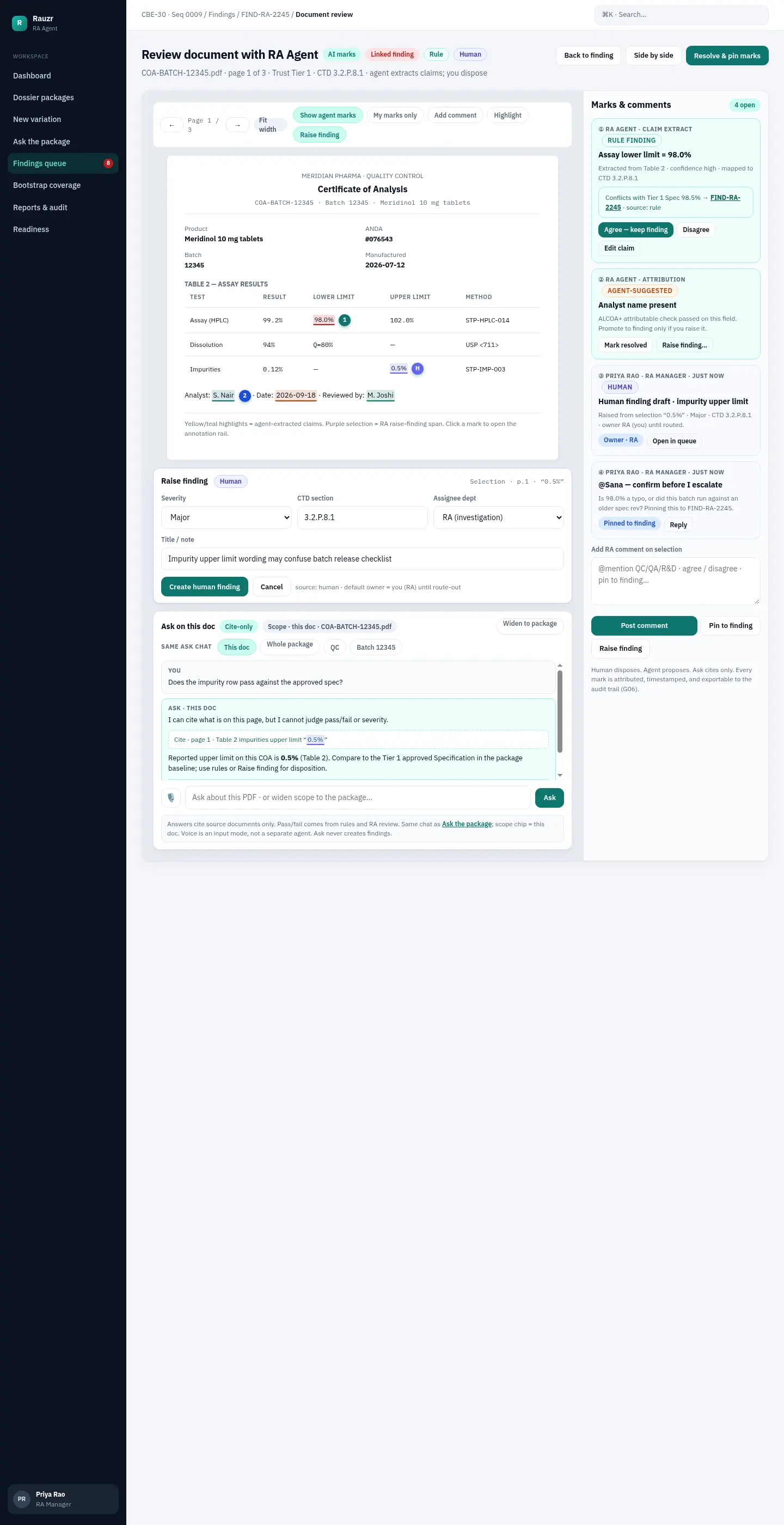
On the document, marks and a human finding.

Document review opens the source — a certificate of analysis, a specification, a report — with agent marks on the values the rules are using. A reviewer can agree, keep a mark pending, or dispute it, and can jump to the linked finding.

Raise finding is a human action: severity, CTD section, assignee, and a note. Ask on this document is cite-only. It can report what the page says. Disposition goes to the rules or to Raise finding. The model does not judge severity.

Dossiq · Document reviewSample data
Dossiq document review of a sample certificate of analysis. Agent marks highlight assay values. The reviewer can agree, dispute, or raise a human finding. Ask on the document cites that document only.

Scroll inside the frame to see the full screen

Sample variation in the Dossiq interface. Not a customer result or a performance claim.

07

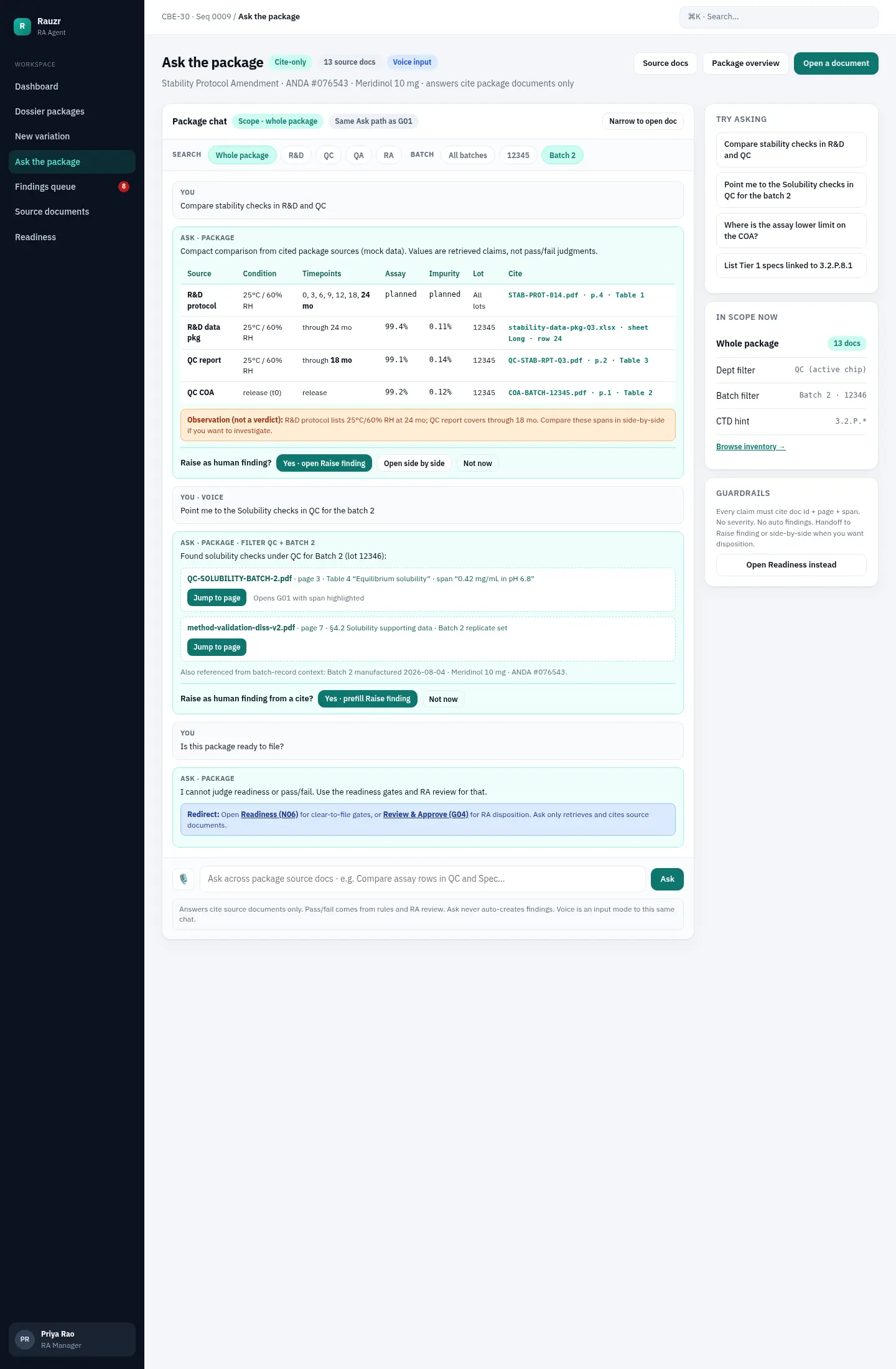
Ask answers. It does not dispose.

Ask the package runs over the whole package or a slice: R&D, QC, QA, a batch, a document. A comparison comes back as a table — source, condition, timepoints, assay, impurity, lot — with the file and the page. An observation is labeled as not verified when the check has not been run.

“Is this package ready to file?” is refused. The product points to readiness gates and to Review & Approve. Ask does not open a finding. Voice is only another way to type the question.

  • Citations are document, page, and span.
  • No severity and no automatic finding from a question.
  • Side-by-side and Raise finding are the handoff when a person wants a disposition.
Dossiq · Ask the packageSample data
Dossiq Ask the package showing a cited stability comparison across R and D and QC, an observation marked not verified, and a refusal to judge whether the sample package is ready to file.

Scroll inside the frame to see the full screen

Sample variation in the Dossiq interface. Not a customer result or a performance claim.

Judgment

Rules flag it. People decide.

Every finding has a rule and a citation. Dossiq keeps machine checks and human judgment separate, and named on the record.

  1. Model

    Extracts, with a page.

    Reads R&D, QC, QA, and prior filings. A fact without a document, page, and span is not an answer.

  2. Rules

    Find the discrepancy.

    Deterministic checks compare those facts. The rule id is stored on the finding.

  3. RA

    Decides and files.

    Agree, dispute, waive with a justification, or raise a finding the rules did not.

On the screen

The product says this to the reviewer.

Screens are the Dossiq interface with sample data. They are not customer work and not a performance claim.

“Answers cite source documents only. Pass/fail comes from rules and RA review.”

Ask the package

“No severity. No auto-findings. Handoff to Raise finding when you want a disposition.”

Ask guardrail

“Ask never auto-creates findings. Voice is an input mode to this same chat.”

Ask the package

Export

What leaves the system is for the person who files.

Review & Approve and export are the end of the product’s work. Dossiq can hand a reviewer a package status and a record of findings, citations, and dispositions. It does not transmit a dossier to FDA, EMA, or any other agency.

How judgment, tiers, and the audit posture are split

Rauzr Helix · Dossiq

See a package in Dossiq.

Write to us with the pathway you file — US CBE-30, EU Type IB, or both — and whether you want a walkthrough of a sample variation. Your regulatory affairs team keeps the filing.